
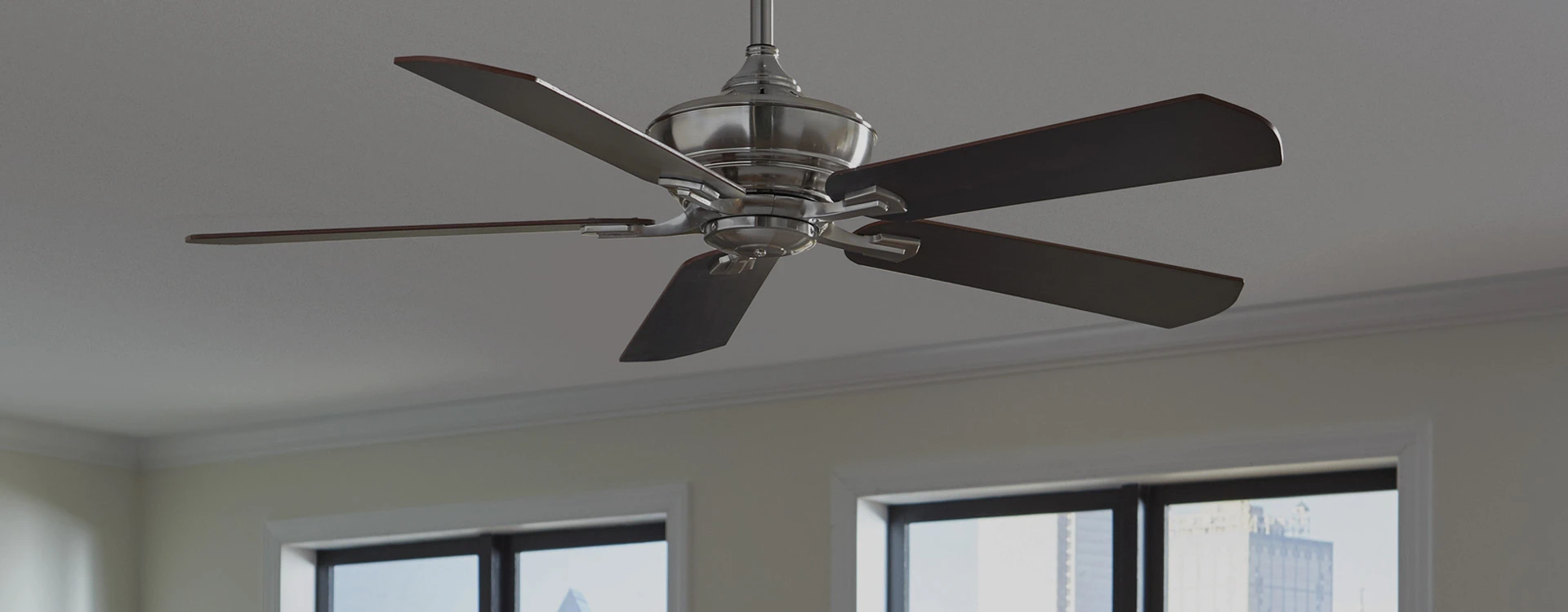
A commitment to quality
Every Fanimation fan is built with an uncompromised commitment to quality materials and craftsmanship. You can find specific warranty information on individual product pages, while product recall details and answers to frequently asked questions are listed below.
Frequently asked questions
GENERAL
>How does distance from the ceiling and walls affect a fan's performance?
>Can I hang my fan on a Sloped Ceiling?
>What is the optimal distance from the ceiling and walls?
- The optimal clearance from the bottom of your ceiling fan’s blades to the floor is 7-9 feet. This not only ensures compliance with safety codes, but also that maximum airflow is felt.
- For ceilings higher than 12 feet, hang your fan at least one-third the distance to the floor while maintaining a minimum of 7 feet of clearance.
- Fanimation offers a wide selection of downrods between 12 and 72 inches long. Downrods can be combined if necessary with the use of a downrod coupler.
- A hugger fan should be installed with a ceiling height of 8 feet or less.
- Ensure at least 24 inches of clearance from all walls and/or tier ceiling and eaves.
>What is the difference between AC and DC ceiling fans?
DC fans generate more power and torque than conventional AC ceiling fan motors while consuming around 70% less power. They are virtually silent and require less electrical current by utilizing an internal array of magnets of opposing polarity. Many of our DC fans have earned the energy star, which will help with electrical costs.
While using slightly more energy compared to DC ceiling fan motors, AC fan motors are generally less expensive, simpler and more reliable than their DC counterparts.
>What type of location rating does my ceiling fan need?
Fans are categorized into three different location ratings – Dry, Damp, and Wet.
- Ceiling fans with a dry location rating are suitable for indoor installation only and should not be installed in a high humidity environment such as a bathroom.
- Ceiling fans with a damp location rating can be installed in any indoor setting or covered outdoor locations such as covered porches.
- Ceiling fans with a wet location rating can be installed in any indoor or outdoor setting, including those where direct contact with water would be likely.
>Are lightbulbs included with Fanimation light kits?
Yes, bulbs or integrated LED modules are included with any light kit, depending on design.
>Where can I find the Owner's Manual and Specification Sheet for my fan?
Current specification sheets and owner’s manuals are available under the Support Documents tab for each fan online at fanimation.com. Historical fan information can be obtained by contacting Customer Care—888-567-2055 or techsupport@fanimation.com
>What do the icons mean on my remote control?
Please refer to our remote control features:
TROUBLESHOOTING
>Why do I not feel much air from my outdoor ceiling fan?
Any setting with no walls allows for air leakage. Ensure your fan is installed 7 feet from the ground and check that the airflow direction is blowing air downward—reverse your airflow direction if necessary.
Choosing a fan with higher RPM can also increase the feeling of air from your fan.
>Why is my fan and/or fan light turning on or off unexpectedly?
>My fan is wobbling or making noise. What should I do?
- Ensure all screws are properly tightened.
- Ensure that the fan-rated junction or outlet box is secured to the joist or block, and the hanger bracket is securely attached.
- Verify that the hanger ball is properly seated in the provided hanger bracket.
- Verify proper installation of blades and blade holders.
- Confirm that all packaging motor stops have been removed.
- Ensure the light plate is not upside down (if included).
fanSync WiFi
>What are the network requirements for fanSync WiFi control?
>What is the range between the router and ceiling fan?
>How do I link my fanSync WiFi control with Amazon Echo, Google Home and IFTTT?
>How many ceiling fans can be on the fanSync WiFi app?
>My fan isn't connecting or functioning properly using the fanSync app or with my smart home device. What can I do?
Technical Support Form
Product Registration
Why register? Every Fanimation fan is backed by our firm commitment to quality materials and manufacturing. Product registration is optional — however it will help us quickly inform you of any safety issues and make any warranty-related services go faster and smoother.